
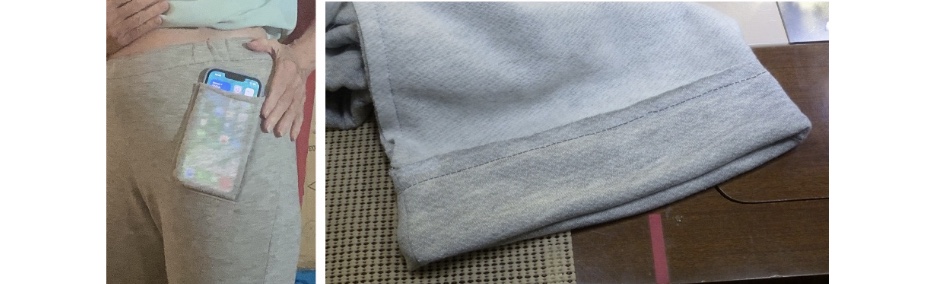
Adding a bellows phone pocket and weighting the hem.
Personal notes:
These are adaptations I routinely make to my standard sweatshirt fleece pants, but either or both can be added to any pattern. The pants in this demo have comfortable wearing ease but are not as full as pajama pants. Their non-roll elastic at the waist is stitched vertically at the center back and side fronts (the gathers were smoothed away from the front first) which prevents twisting in the laundry. My phone sits in its charger by where I work, and I take my backpack when I go out, so the phone pocket is mainly for trips to the mail area or laundry room.
Weighting the hem keeps the legs from twisting and crawling up.
Adding a phone pocket (usually to the left hip):
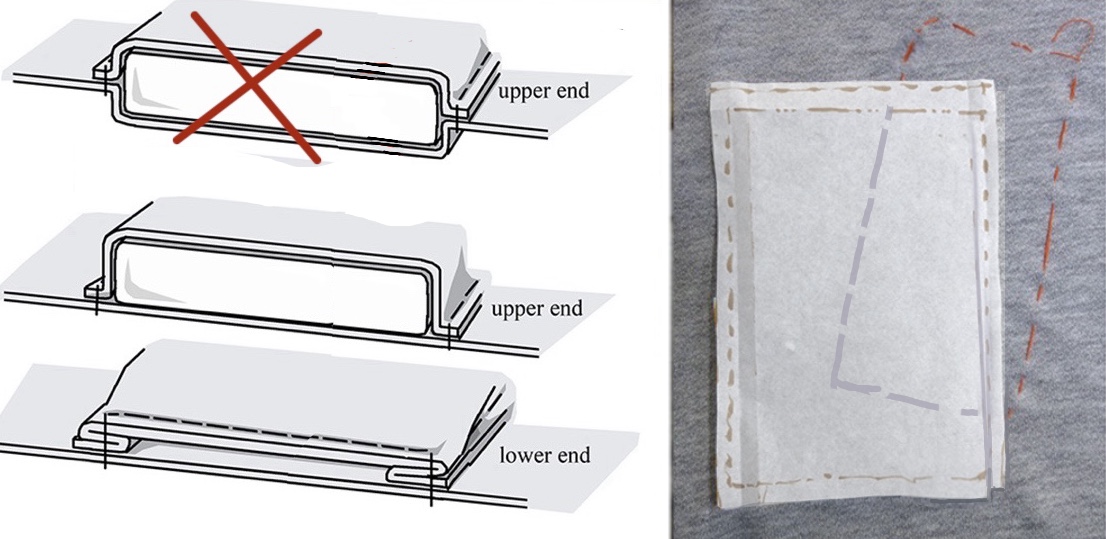
A flat patch pocket is not what we want here, but a bellows. Those tiny pleats mean that the phone floats above the pants’ fabric, making it easier to slide in/out. A welt pocket is more elegant, but more fuss to sew and, for me, the bulge of my phone underneath the pants next to my body is less comfortable to wear.
- Hold the phone up to your hip wearing a comparable pair of pants to figure the pocket placement.
- Chalk its outline (or use a soluable marker) – here I’ve thread-basted it so that you could see it.
- Make your pattern: the outline of the phone plus the hem at the top, bellows pleats at the sides, and seam allowances all around. The pocket needs to be enough wider than a tight wrap so that the phone slips in/out easily.
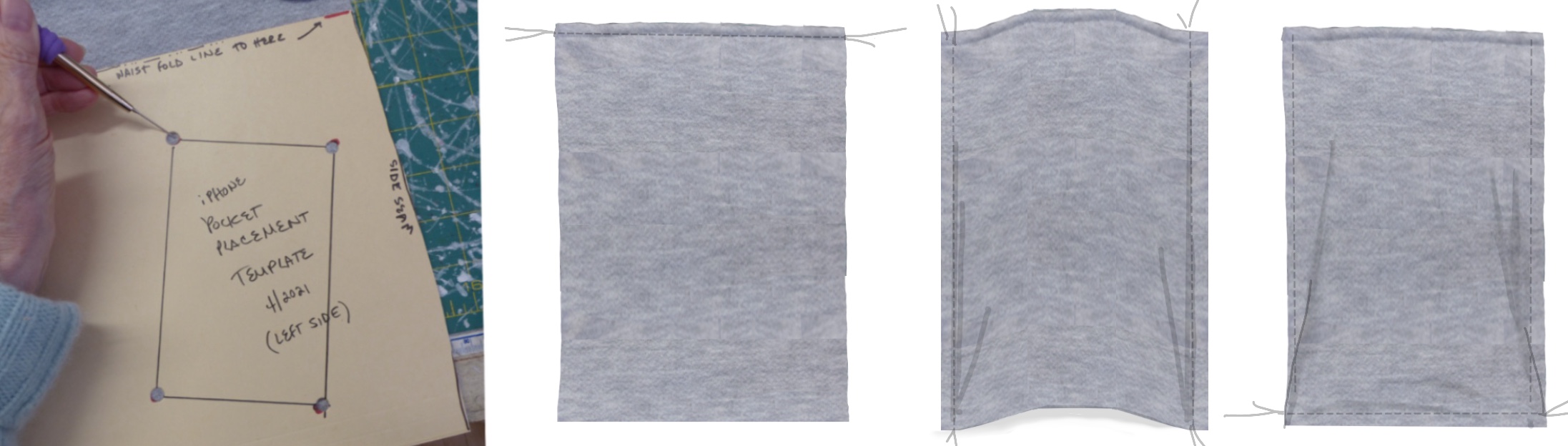
As I will be sewing this pattern repeatedly, I use the industry’s trick of making a template for exact placement. There’s a nip in the side seam to show where to fold down the waistband, so the template runs from that down the side. Poke through the center of the punched holes (a sewing machine needle pushed completely through) and barely cover the little holes in the fabric with the finished corners. They are stitched over so are not a weak point. If you tried to move the dart in a commercial blouse and were dismayed to find a hole at the point, that’s why and how it got there.
- Sew the top hem.
- Place on the left front pants piece, bringing the sides in to cover the punched marks. Sew the two vertical sides.
- Fold the bellows into the bottom at the sides and stitch across.
Save your fabric scraps in case your next phone is bigger and you need to replace the pockets!
Weighting the hem:
Pattern prep: nips in the inseam and outseam for the hem fold and for where the bottom edge will turn up to.
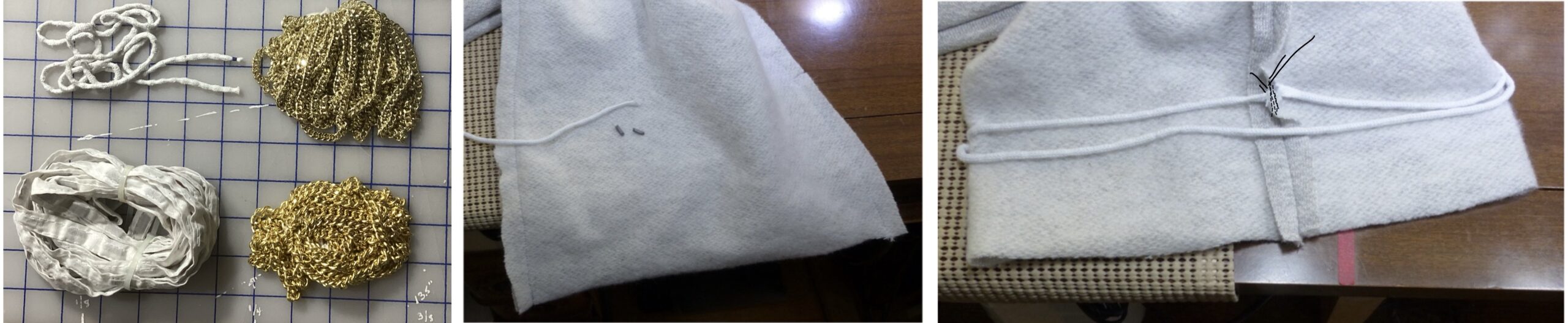
The drapery/upholstery area of a fabric store will have weighted tapes and cords. I use the pellets in a thin tube, upper left.
Also shown are metal rectangles in a casing for heavy drapes, and two weights of gold-plated chain from Chanel (real!), meant to be seen when you slip off your jacket and fold it over the back of your chair meeting friends for luncheon, or at your political fundraiser.
We’ll be putting ours inside the fold of the hem.
As you’re adding it at the end of the construction right before the hemming, pin some in to see what you need: usually two rounds for sweatshirt fleece pants, one for thinner cotton or linen. Three for the hems of heavier tweed jackets.
WAWAK weighted cord (This is for a 65 yard spool – how I buy it – but will show you what to look for)
The ends of the cord are tacked to the seam allowance. Figure how much cord is needed to loosely wrap the pants leg. Tease out pellets at each end so you don’t hit them with your needle, and tack in place to lie right in the fold of the hem.
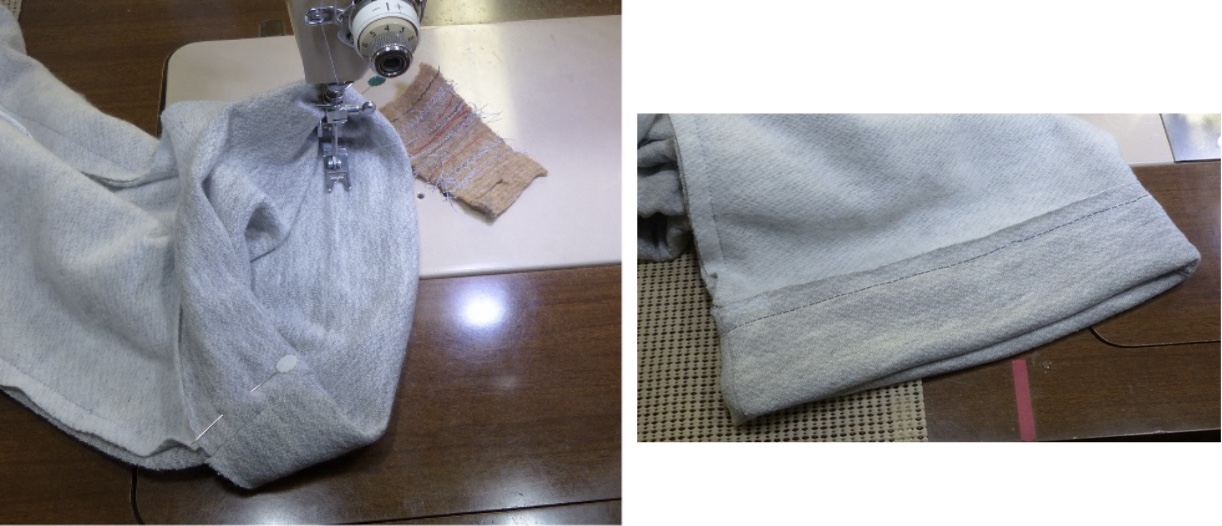
Turn the hem into place and sew by machine, as here, or by hand. The weight doesn’t need any securing beyond its ends: it can’t go anywhere.
Tuck your pattern and template into your pattern for next time.